America’s Bishop … The Life and Times of Fulton J Sheen
Thomas C. Reeves
Encounter Books
San Francisco, Calif. 2001
My review of this riveting biography of the life of Fulton J. Sheen has been preempted by breaking news. And I must say I am thrilled with this news — as I am sure are so many other Catholics to hear that Venerable Fulton J. Sheen will soon be beatified — the first step in the canonization process.
I can think of no American Catholic cleric who has had such a lasting impact on Catholics and people of all faiths — his influence was that powerful.
The next step is the celebration of his beatification in which Fulton Sheen would be declared Blessed by Pope Leo. This seems imminent.
In 2019, Pope Francis approved a 2010 miracle attributed to the intercession of Archbishop Sheen that had no medical explanation.
The child, James Fulton Engstrom — named after Bishop Sheen during his mother’s pregnancy — was conceived stillborn at home and rushed to the hospital by ambulance where he showed no signs of life and had no pulse. His heart stopped beating for more than 61 minutes despite CPR and medical efforts. The child’s mother repeatedly invoked the bishop’s name.
Just as the doctors were about to declare him deceased, the infant’s heart resumed beating. There was no logical medical explanation for this turn of events that could be explained naturally by the Vatican-approved medical and theological panels. Against all medical expectations, the child made a full recovery with no lasting impairments.
In Bishop Sheen’s later years, edging towards retirement at age 75, the honorary title of archbishop was conferred upon him by Pope Paul VI.
Archbishop Sheen died in Manhattan in 1979, and his body was entombed in St. Patrick’s Cathedral. His cause for sainthood originated in 2002 in the Diocese of Peoria, Illinois — the diocese of his birthplace in El Paso, Ill..
In 2016, his closest living relative, his niece, Joan Sheen Cunningham, sued to have his remains moved to Peoria. New York officials disputed the move in court but ultimately ran out of options and his remains were transported to St. Mary’s Cathedral in Peoria in the summer of 2019.
Bishop Sheen said he would “meet with anyone who had a theological problem.”
He converted many — people he would meet randomly and people in high places.
His faith in the supremacy of the Catholic religion was unerring as reflected in these words, “If I were a Catholic and were looking for the true Church in the world today, I would look for the one Church that did not get along well with the world. I would look for the Church that the world hates … If it is unworldly, it is other-worldly. Since it is other-worldly, it is infinitely loved and infinitely hated as was Christ Himself.”
Today, with the Catholic Church facing significant, violent and systemic assaults in the United States and globally, Fulton Sheen’s words seem almost prophetic.
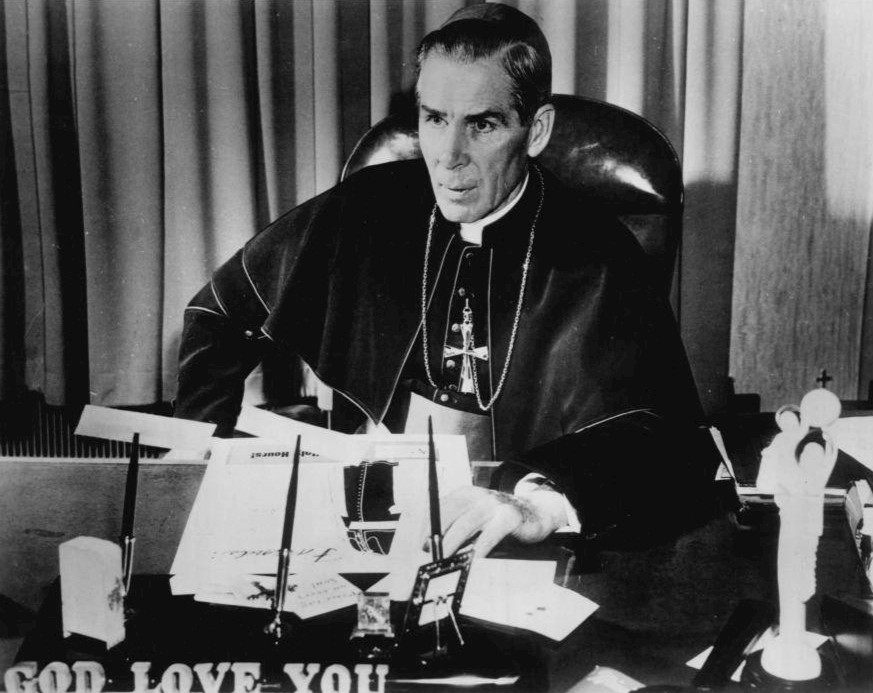
Sheen was the most popular and in-demand speaker in the modern-day history of the Catholic Church. He was heard around the world on the “Catholic Hour” radio program from 1930 to 1952 and launched his TV show “Life is Worth Living” in 1952 while still teaching at Catholic University in Washington, D.C. It was one of the most popular religious programs in television history and won multiple Emmy Awards — making Bishop Sheen a household name. He combined simple lessons with profound concepts and ended every show with “God love you.”
And whenever he was scheduled to preach at St. Patrick’s Cathedral in New York, 6,000 people regularly packed the Church. On Easter Sunday, 1941, 7,500 worshipers were jammed into the cathedral, while 800 waited outside.
On Good Friday, Sheen’s sermons were broadcast outdoors to the thousands standing outside St. Patrick’s Cathedral. Many of Sheen’s television shows, sermons and speeches are still available on videocassette and tape. That is how powerful and inspirational he was — and continues to be.
In December 1956, Bishop Sheen ranked third among Americans for most admired man in the world. At 61, he was host of a popular national TV show, a celebrated radio personality, and sought after public speaker. Wherever he appeared, he was greeted with thunderous applause.
Yet his fame was peaking and within a year, his TV show ended amid circumstances that possibly stemmed from a bitter falling out with Cardinal Francis Spellman, the archbishop of New York. Sheen was exiled and transferred to the diocese of Rochester. His three years in Rochester were difficult. He had been used to drawing thousands all over the world to his speeches. But when he gave a series of retreat talks in Rochester, few people came — according to Thomas Reeves, the author of this book.
“The whole world comes to hear Fulton Sheen, except his own diocese,” Sheen told a priest, according to this author. He found the diocese frustrating and untenable. When he resigned as bishop of Rochester in 1969 at the age of 74, he was a year away from the mandatory retirement age and in good health. “It wounded him that he was rejected by these people,” the author says.
Sheen’s retirement during his last 10 years was active but out of the spotlight. In the twilight of his life when he had time to look back and reflect, he lamented what he considered defects of his past life including his vanity and his luxury. He acknowledged his taste for recognition, applause, titles, fine clothes and Cadillacs — and considered his mortifications slight. With his failing health, he felt his physical suffering brought him closer to the suffering of Christ on the cross. And for the entire 60 years of his priesthood, he spent his daily holy hour kneeling before the Blessed Sacrament keeping the promise he made to the Lord.
Monsignor Jason Gray, the executive director of the Archbishop Sheen Foundation in Peoria, Illinois, sees the last decade of Sheen’s life as a vital part of his story. In an interview with the Catholic Register, he said “I think that those 10 years were kind of a purification for him. Suffering brought him in close relationship with Christ.”
His struggles in his later years with Cardinal Spellman took a toll on him. They disagreed with how the funds Sheen raised for the National Society for the Propagation of the Faith should be used. As the director of the organization, Sheen thought he was the rightful decision maker. What began as a disagreement turned ugly. Spellman’s animosity extended beyond unpleasantness. He called Sheen “the most disobedient priest in the country.” Sheen was an outlier among clerics in the Archdiocese of New York and according to this author, “He lived daily with Spellman’s wrath hovering over him.”
Yet, when Sheen wrote his autobiography almost a decade later, he omitted all details about his conflict with Spellman — mentioning Spellman eight times in a positive vein. In his 2014 book on Bishop Sheen, Monsignor Franco observes, “This goes to show you the humility of this guy and the sanctity of this wonderful man.”
Sheen’s appointment to the diocese of Rochester is thought to have been engineered by Spellman to make sure Sheen would not succeed him as archbishop.
Throughout his life he gave millions to charity from his book royalties, salaries and gifts. He would drop everything for a single person in need.
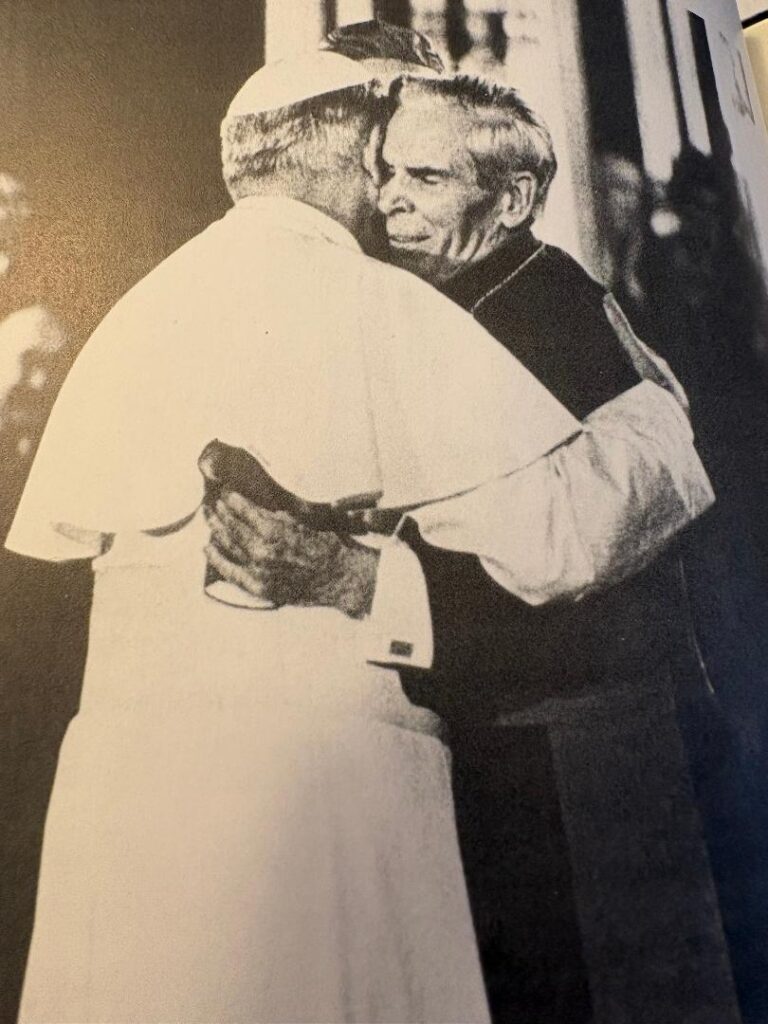
When Pope John Paul II visited New York City in 1979, at a packed St. Patrick’s Cathedral in Manhattan, Sheen at that time feeble, knelt before the Pope ,who grabbed him by both arms and quickly helped him to his feet. They had a brief though emphatic conversation, with the Pope putting both hands on Sheen’s shoulders three times as the two men spoke face to face inches apart, while the congregation erupted in thunderous applause.
When asked what the Pope said to him, he replied, “He told me that I had written and spoken well of the Lord Jesus, and that I was a loyal son of the Church.”
Sixty-eight days later, on the morning of Sunday, Dec. 9, 1979, Sheen celebrated Mass and practiced part of the Christmas sermon he was planning to give at St. Patrick’s Cathedral, according to the author.
Early that evening, Reeves writes, “he died in his chapel before the Blessed Sacrament.”
About the author: Dr. Thomas Reeves is a noted historian specializing in 20th-century American history. A former Episcopalian, he was reared Lutheran and became Roman Catholic after discovering that the Catholic Church is the only Church that teaches with the authentic authority of Jesus Christ. He is author of “The Empty Church: The Suicide of Liberal Christianity” and “America’s Bishop: The Life and Times of Fulton J. Sheen” and “A Question of Character: A Life of John F. Kennedy.”